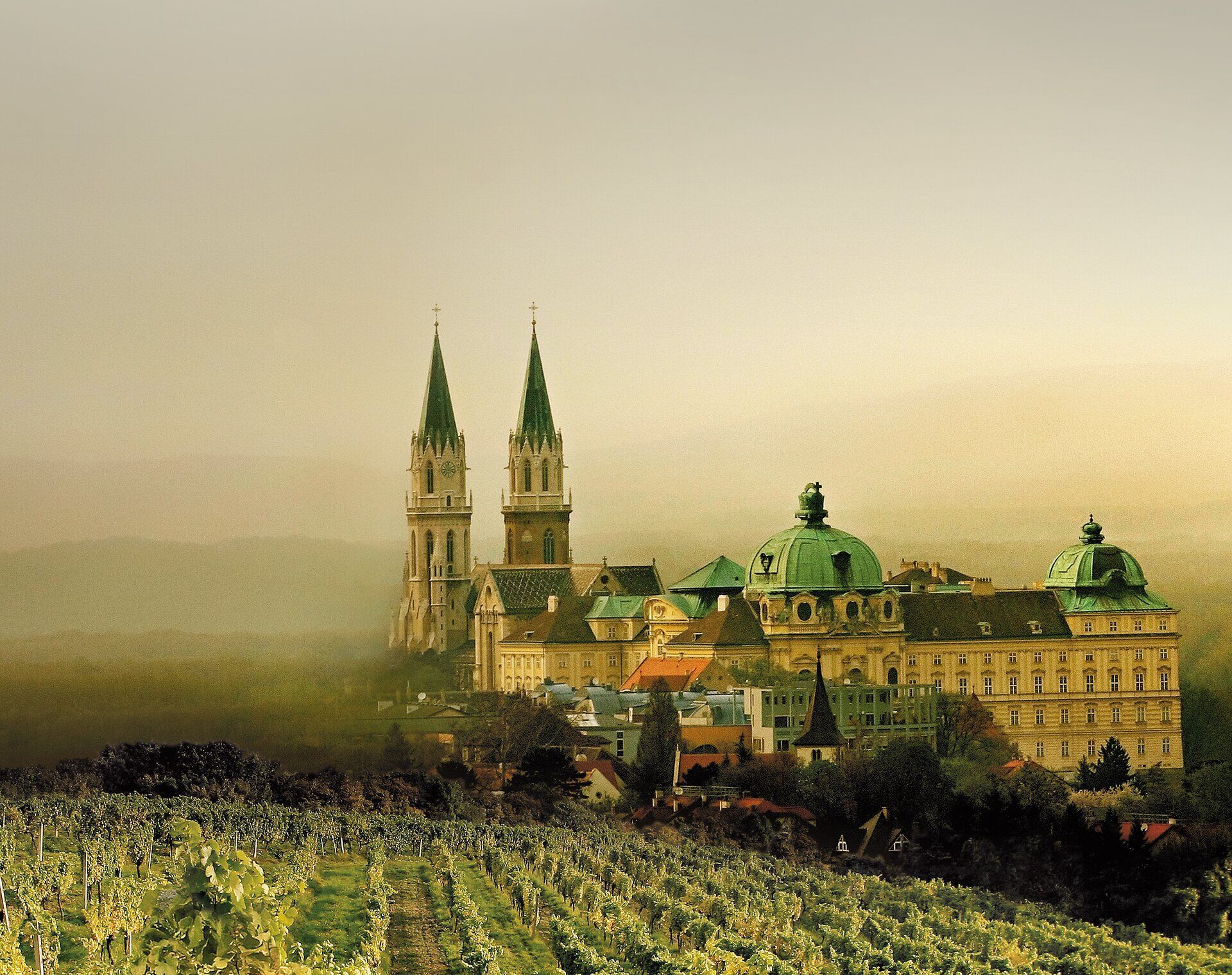
Immerse yourself in the history of Klosterneuburg!
From the Babenbergs, centred on Margrave Leopold, to the traces of the Turkish sieges – the town’s eventful past can still be experienced and felt in many places today.
The famous legend of the founding of Stift Klosterneuburg
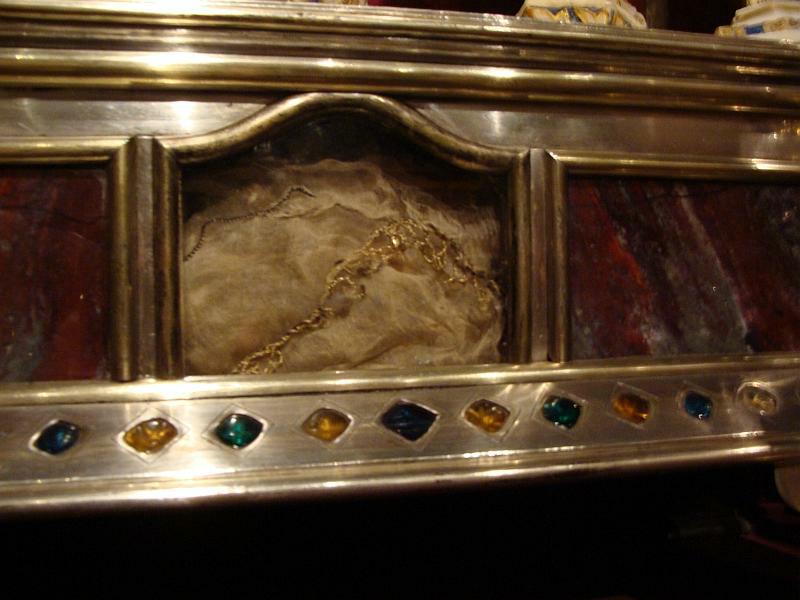
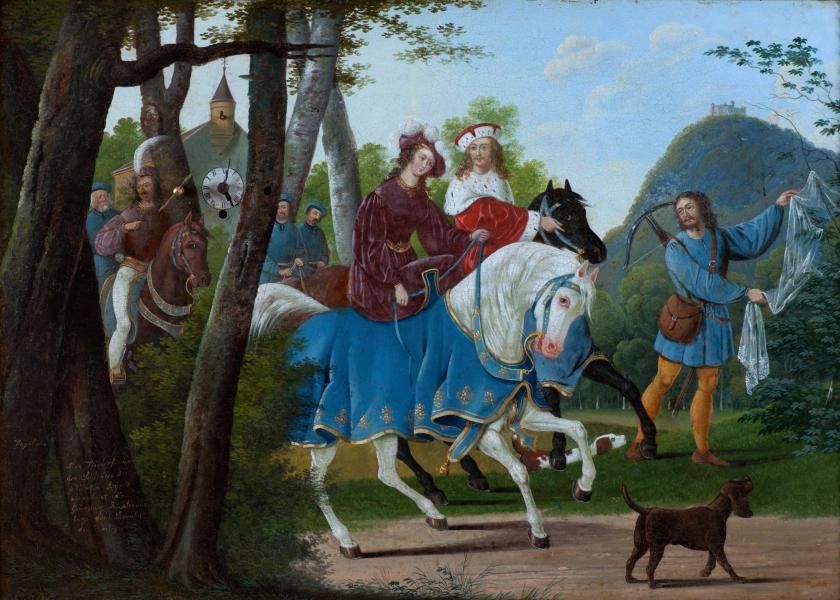
A VEIL FOR KLOSTERNEUBURG
Whilst Margrave Leopold and his wife were conversing by an open window in the castle on the Kahlenberg and, in Christian zeal, prayed that that Heaven might show them, by a sign, the most suitable and God-pleasing place for the foundation of a church and a monastery, lo and behold, suddenly, amidst a beautiful, calm and clear sky, by divine providence, the head veil of his virtuous wife Agnes was caught by an unexpected gust of wind and carried into the dark forest near the Danube —before both their eyes and in the first year of their marriage, in the year 1106.This veil, which to this very day is duly preserved and displayed amongst other relics at Klosterneuburg as a symbol or mark of the church that was founded, remained safe from wind, rain and snow, and from both humans and irrational animals, remaining undamaged and unharmed as it hung in the forest, and was finally discovered in the ninth year by Saint Leopold, the Margrave, whilst he was hunting in this part of the forest; it lay spread out on an elder tree (whose trunk still exists) amongst the undergrowth and hedgerows, revealed by the barking of the hunting dogs. Since Saint Leopold, upon finding the veil, realised that God had miraculously shown him this spot for the construction of the church he had intended to build, he immediately brought the veil (which had remained intact on the elder tree for so many years) brought home to his wife, full of joy, and explained the miraculous discovery in full detail, whereupon she was overjoyed and is said to have addressed Leopold with words to the effect: ‘Beloved husband, this is the place which God wishes to be consecrated to Him.’Leopold therefore had the forest cleared without delay, the trees and shrubs uprooted, the site prepared, the area cleared, and all necessary arrangements made for the construction. However, as Leopold did not recognise this site as his own freehold, he had himself publicly proclaimed the rightful lord of this land in all towns and market towns for five consecutive years, for greater certainty, and paid double the value of their land to those who could duly prove a legitimate claim to it. In this way, on 12 July 1114 – since the necessary materials had already been procured – the foundation stone was laid and building commenced at the spot where the elder bush with the veil had once stood.
Source: Adam Scharrer, Oesterreichische Marg-Graffen ... – Vienna 1670
Neolithic Period & Antiquity
: The earliest traces of human settlement in Klosterneuburg date back to the Neolithic period.
A continuous settlement pattern only began to develop from the mid-1st century AD onwards with the establishment of a Roman military camp for auxiliary troops, the westernmost in the province of Pannonia. Numerous archaeological excavations bear witness to Roman life and the settlement of the site right up to the 5th century; several theories have been put forward in the past regarding the name of this fort, and its identity remained unclear for a long time.In 2017, following extensive research, the ancient name of the Roman camp of the ‘Tribunus cohortis Arrianis’ was rediscovered and presented as part of the annual exhibition at Stift Klosterneuburg in 2018!
Middle
Ages Following the final conquest of the Avar Empire by the Frankish Emperor Charlemagne, a manor with a St Martin’s Church was established in the village of Omundesdorf in the Bavarian Ostland, which may well have been the site of present-day Klosterneuburg. Verifiable settlement of the high plateau did not resume until the 11th century.
The oldest surviving written reference to the town as ‘Nivvenburc’ (Neuenburg) dates from 1108. It is found in the book of traditions of Stift Klosterneuburg.
The town gained great importance around 1113, when Margrave Leopold III established a stately capital here. Leopold III, who was married to Agnes, the daughter of Emperor Henry IV, built his new residence on the outskirts of the Upper Town; its layout and scale befitted the imperial prince’s status. In 1114, Leopold III ceremoniously laid the foundation stone for a new, monumental collegiate church. The church was originally a college for secular canons and was not converted into an Augustinian collegiate foundation until 1133. Even at that time, Neuburg had already attained the extent it was to retain for centuries. The Danube posed a major threat to the inhabitants of this settlement, but was also, at the same time, its lifeblood, as a large proportion of trade goods were transported by water. Frequent flooding forced the inhabitants living on the far side of the Danube further and further inland, with the result that by the beginning of the 13th century, the two districts had developed separately into Neuburg ‘monastery-side’ (Klosterneuburg) and Neuburg ‘market-side’ (Korneuburg). This natural division caused great difficulties for the inhabitants, which did not go unnoticed by Albrecht I, who had a new castle built in Neuburg in 1288 to serve as his residence. In 1298, Albrecht I separated the two halves of the town and granted a new town charter to Neuburg klosterhalben, which was in fact the older settlement centre.
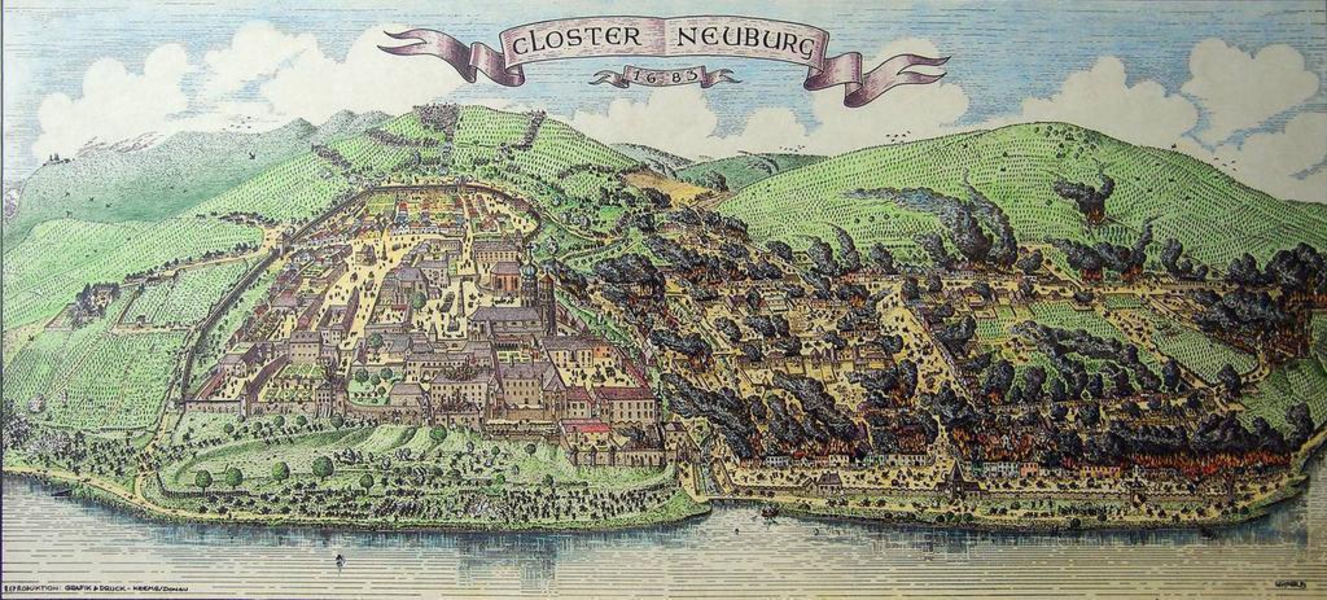
The Lower Town (today’s town square and St Martin’s Quarter), which was poorly fortified and therefore difficult to defend, was repeatedly left exposed to enemy sieges. It was plundered and destroyed on several occasions, whilst the population sought refuge in the strongly fortified Upper Town. This was particularly the case during the Turkish sieges of 1529 and 1683. The fact that the town was able to hold out until the very end in 1683, despite its meagre forces, and thus provide vital flank protection as the allied Christian armies advanced to relieve Vienna, was primarily due to the efforts of two canons and the strong solidarity between the abbey and the town.
Modern era
In 1763, Wilhelm Rudolph, Baron von Ripke, founded the Klosterneuburg shipyard, which was the very first Austrian shipyard. In the 18th century, Emperor Charles VI wanted to transform Stift Klosterneuburg into an Austrian Escorial, that is, a stately monastic residence. However, following the death of Charles VI, the project stalled and progress became increasingly sluggish over the following decades, until it was finally abandoned in 1842. Only one of the four planned inner courtyards and only two of the nine domes were ever completed. The latter can be seen from afar and feature the Imperial Crown and the Austrian Archducal Crown, which symbolise the titles of sovereignty of the House of Habsburg.
In 1805 and 1809, the town was occupied by French troops; on 20 December 1805, Napoleon I paid a brief visit to Stift Klosterneuburg.
In the mid-19th century, Klosterneuburg was still a self-contained little wine-growing town with just under 5,000 inhabitants. With the expansion of transport links to Vienna, many Viennese civil servants and workers chose Klosterneuburg as their new home. From 1908 to 1919, the Weidling Municipal Trolleybus Service – one of Austria’s first trolleybus services – also operated between Klosterneuburg-Weidling railway station and the town of Weidling. By the 1930s, Klosterneuburg already had a population of over 15,000.
The Nazi
era With the ‘Anschluss’ to the German Reich in 1938, not only did Austria lose its independence, but Klosterneuburg also forfeited its autonomy. On 15 October 1938, the town was incorporated into Greater Vienna and, together with the villages of Gugging, Kierling, Höflein an der Donau, Kritzendorf, Weidling and Weidlingbach, formed Vienna’s 26th municipal district.
Second Republic
In July 1946, the National Council passed a resolution to reintegrate Klosterneuburg and a further 80 municipalities into Lower Austria. However, the Allied Council refused to approve this law for several years, meaning that the reintegration could not be finalised until 1 September 1954. All the territories of the formerly independent municipalities of Gugging, Kierling, Höflein, Kritzendorf, Weidling and Weidlingbach, which existed prior to 15 October 1938, were incorporated into the re-established municipal district of Klosterneuburg. This made Klosterneuburg the (now) third-largest town in Lower Austria.
Following the re-incorporation, Klosterneuburg became part of the Vienna-Umgebung (WU) district; from 1991 until its dissolution on 31 December 2016, it was the seat of the district administration.
Plans to dissolve the WU district were announced in September 2015. Since 1 January 2017, Klosterneuburg has been part of the district of Tulln, as it had been until 1938. However, as this was controversial, other possibilities – such as obtaining its own town charter or being incorporated into Vienna – were discussed as further options. On 1 July 2016, the local council decided to incorporate the town into the district of Tulln, on the condition that Klosterneuburg would be granted its own branch office of the district administration.Since 1 January 2017, this branch office has been located in the building of the former district administration office on Leopoldstraße.

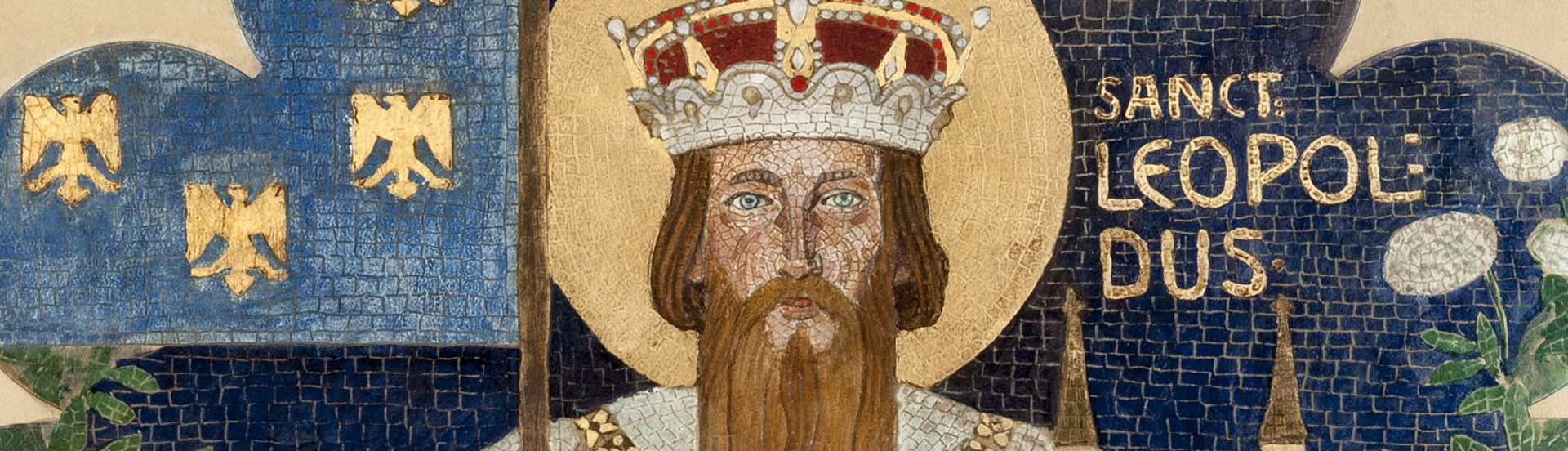
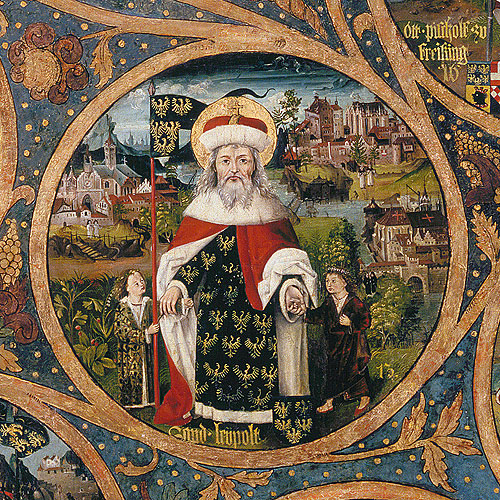
Margrave and patron saint of
Austria* 1073, † 15 November 1136
; Babenberg Margrave of Austria (from 1095); Son of Leopold II, father of Henry II (Jasomirgott) and Leopold IV. In 1105, during the conflict between Henry V and his father Henry IV, he sided with the son and, in return, married Henry V’s sister Agnes. Through this, his second wife, he became related to the Salian and Staufer dynasties; he received the royal estates and imperial rights in the Margraviate of Austria, held the rank of ‘principatus terrae’ (a position above that of a count) and spoke of the ‘ius terrae’. Leopold III renounced his claim to the kingship in 1125. His reign was largely peaceful. During this period, large estates passed to the Margrave as inheritances or dowries, including the Vienna area. Under his rule, several towns on the Danube were granted town status (Stein, Krems with its mint, Tulln, Neuburg, Vienna, Hainburg); Stift Klosterneuburg, Heiligenkreuz and Kleinmariazell were founded by him, Seitenstetten and Baumgartenberg by members of the high nobility, and St Georgen (Herzogenburg) by the Bishop of Passau. The first cultural achievements in Austria took place during his reign (Lady Ava, Henry of Melk, the Melk Annals, the *Vita Altmanni*); notable examples of castle construction included Oberranna and the Palatine Palace alongside the Stift Klosterneuburg (a monastery since 1133). This was the seat of his rule and is where his burial place is situated. His memory is still honoured here to this day. He was canonised in 1485 and has been the patron saint of Austria (and Vienna) since 1663. His feast day is 15 November, which is celebrated every year, particularly in the east of the country and in his ‘hometown’ of Klosterneuburg, with the traditional ‘Leopoldimarkt’!